Singapore Monsoon Dengue Cluster Guide: Comprehensive Home Biosecurity & Aedes Eradication Protocol (2026 Update)
August 12, 2026
SFA Hygiene Audits & Demerit Point Prevention: The 2026 Commercial Kitchen Pest Control Checklist for Singapore F&B Operators
August 14, 2026New HDB BTO & Condo Key Collection: Stopping Booklice and Termites in New Carpentry (2026 Diagnostic Guide)
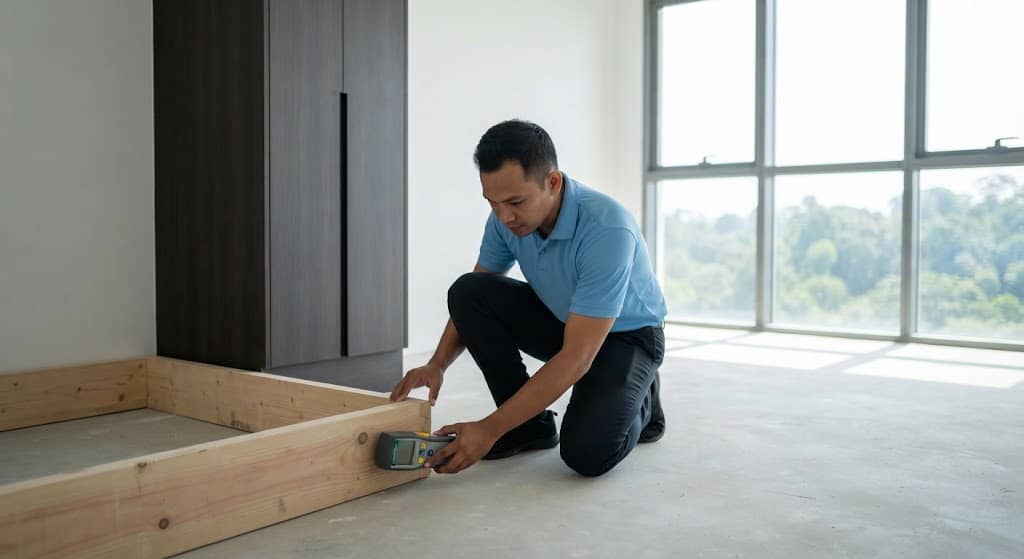
Assessing concrete moisture levels and pre-treating carpentry timber prevents booklice infestations and termite damage in new Singapore homes.
The New Homeowner Paradox: Why Freshly Handed Over Units Breed Pests
Collecting keys to a brand-new HDB Build-To-Order (BTO) flat in estates like Tengah, Bidadari, or Tampines North—or receiving the Temporary Occupation Permit (TOP) for a modern condominium—is a major milestone. Homeowners anticipate a pristine, untouched living environment. Yet, within weeks of moving in or completing custom carpentry installations, thousands of new residents encounter a frustrating, viral reality: walls, skirting boards, and custom kitchen cabinets crawling with microscopic specks, or worse, hollow-sounding floor-to-ceiling wardrobe panels.
A newly constructed apartment is not biologically inert. In reality, a fresh flat contains hundreds of liters of residual construction moisture trapped inside concrete floor slabs, pre-cast structural walls, and skim-coat plaster. When interior designers and main contractors rush the renovation process to meet move-in deadlines, this moisture gets sealed directly behind impermeable laminate sheets, vinyl flooring underlays, and solid plywood carcasses.
Singapore’s ambient climate accelerates this problem. With outdoor relative humidity hovering between 75% and 85% year-round and temperatures averaging 30°C, trapped construction moisture transforms built-in cabinetry into an ideal incubator. The result is rapid micro-mold propagation that attracts massive booklice outbreaks, alongside subterranean or drywood termite introductions brought in through untreated, low-grade imported timber substrates.
The Micro-Ecology of High-Humidity Construction Materials
Understanding how pests colonize new carpentry requires examining the biological drivers behind the two primary culprits: psocids (booklice) and wood-destroying termites. While both appear in newly renovated homes, their food sources, structural impacts, and remediation protocols are entirely distinct.
1. Booklice (Liposcelis bostrychophila): The Fungal Grazers
Booklice are not true lice. They belong to the order Psocoptera and do not bite humans, feed on blood, or transmit infectious pathogens. They are micro-scavengers that feed almost exclusively on the microscopic hyphae and spores of molds (such as Aspergillus and Penicillium) growing on damp building materials. When a carpenter installs unsealed plywood against a freshly screeded concrete wall, capillary action draws water into the back of the timber. As mold blooms invisibly inside the dark, unventilated cavity behind the wardrobe, a founder population of booklice multiplies exponentially, eventually spilling out across internal shelving and vanity counters.
2. Subterranean and Drywood Termites: The Structural Destroyers
Termites consume lignocellulose—the structural polymer that gives wood its strength. In newly handed-over Singapore properties, termite infestations typically originate via two distinct pathways:
- Subterranean Termites (Coptotermes gestroi): Ground-nesting termites that construct mud tubes through expansion joints, electrical conduits, and service riser voids to reach cellulose in skirting boards, door frames, and kitchen base units.
- Drywood Termites (Cryptotermes domesticus): Timber-nesting species that do not require ground contact. They are frequently imported directly inside cheap, unseasoned core boards, pallet wood, or un-fumigated timber framing during the fabrication phase at overseas carpentry workshops.
Concrete Screed Dynamics and Moisture Retention in Singapore Flats
The primary environmental catalyst for post-key collection pest issues is “green” concrete. During the construction of HDB flats and private condominiums, hundreds of metric tons of water are mixed into the concrete screed and masonry plaster. Under Singapore’s high atmospheric humidity, water vapor takes significantly longer to evaporate from thick floor slabs compared to dry, temperate climates.
The standard rule of thumb for concrete slab drying is roughly 30 days per 25 mm of slab thickness under optimal, continuous air movement. However, newly handed-over flats often sit completely closed with windows shut for weeks during the Defect Liability Period (DLP). Moisture remains suspended in the screed at levels exceeding 15% to 20% Wood Moisture Equivalent (WME).
When renovation contractors immediately lay closed-cell foam underlays for luxury vinyl tiles (LVT) or mount floor-to-ceiling carpentry flush against unsealed masonry walls, that trapped water has only one escape path: evaporating straight into the porous, unfinished rear panels of your custom cabinetry. Once the internal timber moisture content passes 12% WME, fungal spores germinate within 48 to 72 hours, creating the baseline food supply required to trigger an uncontrollable booklice explosion.
Screed Moisture Evaporation Dynamics vs. Fungal & Booklice Colonization Thresholds
Readings based on 50mm pre-packed cement screed measured at 30°C and 80% baseline relative humidity.
Diagnostic Differentiation Matrix: Identifying Wood-Borne Pests in New Carpentry
Accurately identifying the pest invading your new carpentry is essential for choosing the correct remediation strategy. Misdiagnosing booklice as termite nymphs often leads homeowners to spray useless consumer insecticide aerosols that scatter the insects deeper into wall voids without addressing the root cause.
| Pest Species | Physical Profile & Size | Primary Food Source | Visible Frass / Structural Signature | Damage Threat to Carpentry |
|---|---|---|---|---|
| Booklice (Liposcelis spp.) | 1.0–1.5 mm; translucent pale brown/grey, soft-bodied, wingless, fast jerky movements. | Microscopic fungi, surface mold spores, starch adhesives in wallpaper/laminates. | No frass or wood powder; insects congregate in swarms along laminate joints and hinge plates. | Zero Structural Damage (Nuisance & Allergen Vector) |
| Subterranean Termites (Coptotermes gestroi) | 4.0–6.0 mm (workers); creamy white body with pale brown head capsule; blind, soft-bodied. | Sound structural timber, solid plywood cores, paper backing on plasterboard. | Earthen mud tubes along skirting boards; hollow-sounding wood veneer; bubbling paint. | Severe Structural Collapse (Destroys Entire Flat Framing) |
| Drywood Termites (Cryptotermes domesticus) | 5.0–7.0 mm (alates/soldiers); cylindrical body, dark brown soldiers with plug-like heads. | Dry, seasoned timber cores inside imported solid wood doors and wardrobe frames. | Hard, hexagonal, sand-like fecal pellets (frass) pushed out from tiny pinholes (kick-out holes). | High Localized Damage (Hollows Out Internal Joinery) |
| Powderpost Beetles (Lyctinae) | 2.0–5.0 mm (adults); elongated, reddish-brown to black beetles; C-shaped white larvae. | Starch content in sapwood of tropical hardwoods and untreated core veneers. | Ultra-fine, flour-like wood dust accumulating beneath clean 1–2 mm round exit holes. | High Timber Degradation (Reduces Plywood Core to Dust) |
Pre-Renovation Moisture Diagnostic Protocols: Testing Before Carpentry Installation
Preventing post-renovation infestations starts before your interior designer begins on-site carpentry measurements. Relying on visual inspections alone is inadequate; concrete can appear dry to the touch on its surface while remaining saturated at its core.
Every homeowner and project manager should implement a rigorous two-step moisture validation protocol:
1. Quantitative Digital Moisture Metering
Utilize both pin-type and pinless electromagnetic moisture meters across all floor screeds and masonry walls before carpentry framing begins. Key diagnostic benchmarks include:
- Concrete Floor Screed: Must measure below 4.5% Moisture Content (MC) or below 75% Relative Humidity (via in-situ probe) before laying vinyl planking or constructing low platform beds.
- Masonry Walls: Must read below 12% Wood Moisture Equivalent (WME) before mounting floor-to-ceiling wardrobe backings flush against plaster.
- Delivered Plywood Panels: Raw carpentry core boards delivered to your flat must register between 8% and 11% internal wood moisture content. Any timber registering above 14% MC should be rejected and returned to the supplier.
2. Substrate Chemistry and Low-VOC Glue Vulnerabilities
Modern sustainability trends emphasize E0 and E1 low-formaldehyde adhesives in plywood fabrication. While these eco-friendly glues improve indoor air quality by reducing chemical off-gassing, formaldehyde historically acted as a natural fungicide and biocide within resin matrices. Modern E0 boards have lower innate fungal resistance; if exposed to high construction humidity, they support mold growth and booklice colonization much faster than older commercial-grade plywoods unless treated with non-toxic mineral preservatives.
Chemical and Physical Wood Pre-Treatment Protocols for New Carpentry
Preventing pests in custom built-in furniture requires proactive defense before the first board is mounted to your wall. Once a floor-to-ceiling wardrobe or kitchen island is installed, treating the rear face of the timber without dismantling the entire structure becomes practically impossible. Implementing both chemical impregnation and physical isolation protocols creates a durable defense barrier against wood-destroying organisms.
1. Borate Mineral Salt Impregnation (DOT Treatment)
Disodium Octaborate Tetrahydrate (DOT) represents the gold standard for interior timber pre-treatment. Unlike synthetic neurotoxin insecticides, borate salts are natural minerals with low mammalian toxicity, making them completely safe for indoor residential applications. When applied as an aqueous solution to raw, unlaminated plywood cores, the borate ions diffuse deep into the wood cellular structure.
- Dual-Action Fungicidal & Insecticidal Barrier: Borates disrupt the metabolic cellular enzyme pathways of wood-decay fungi (eliminating the food source for booklice) and act as a lethal stomach poison to termite workers attempting to digest the treated cellulose fibers.
- Permanent Protection: Because DOT remains bound within interior dry timber and does not off-gas, a single pre-installation application protects the wood for the entire lifespan of the cabinetry, provided the wood is not exposed to running water.
2. Edge-Banding and Rear-Panel Isolation
Capillary action is the primary mechanism through which raw timber absorbs moisture from newly cured masonry. Standard carpentry fabrication often leaves the rear and bottom edges of plywood panels raw and exposed to save production costs. Enforce these two structural requirements with your main contractor or carpentry workshop:
- 100% Perimeter Edge-Banding: Every single cut edge of plywood—including hidden rear panels, base plinths, and underside shelving—must be sealed with heavy-duty 1mm to 2mm PVC or ABS hot-melt edge-banding. This hermetically seals the porous wood end-grain against ambient humidity.
- The 15mm Masonry Air Gap: Never allow carpenters to fasten timber backings directly flush against external masonry walls. Mandate the use of moisture-resistant PVC shims or aluminum furring channels to maintain a continuous 15mm to 20mm ventilation air gap behind the wardrobe carcass. This allows natural air circulation and prevents condensation transfer.
Active Environmental Conditioning: Dehumidification and HVAC Workflows
Booklice possess extremely permeable cuticles and absorb ambient moisture directly from the air to survive. When indoor relative humidity drops below 50%, psocids lose water rapidly through their respiratory spiracles and desiccate within days. For new homeowners taking key collection in Singapore, managing the internal microclimate during the 4 to 8 weeks post-renovation curing phase is the most effective non-chemical weapon against pest outbreaks.
1. Targeted Compressor Dehumidification
Standard consumer desiccant tubs (the disposable charcoal boxes sold in supermarkets) hold less than 500 ml of water and saturate within days in an unconditioned BTO flat. They are incapable of reducing ambient moisture across an entire bedroom. Instead, deploy commercial-grade or high-capacity domestic compressor dehumidifiers (rated for at least 20 to 30 liters per day) in enclosed rooms with built-in carpentry. Run these units continuously for the first 3 weeks post-renovation, aiming to hold ambient indoor humidity between 45% and 52% RH.
2. Air Conditioner “Dry Mode” vs. Cross-Ventilation
A common misconception among new owners is leaving windows wide open 24/7 during rainy seasons. When outdoor relative humidity spikes to 90% during monsoon downpours, open windows draw saturated, humid air directly into the home, feeding dormant mold spores on unsealed plywood. Use this tactical ventilation schedule:
- Sunny Days (10 AM to 4 PM): Open all internal doors and windows to promote high-velocity cross-ventilation, purging volatile organic compounds (VOCs) and construction dust.
- Rainy Days & Overnights: Seal all exterior windows tightly. Run your split-unit air conditioning systems on “Dry Mode” (Dehumidify) calibrated to 24°C, or run dedicated compressor dehumidifiers to continuously extract moisture from screeds and timber joinery.
Timber Moisture Content (%) vs. Biological Colonization Risk Zones
Equilibrium Moisture Content (EMC) thresholds mapped against internal timber density in tropical residential environments.
Handling Infestations During the 1-Year Defect Liability Period (DLP)
If you uncover live termite activity, mud trails, or severe fungal blooms shortly after receiving your keys from HDB or a private developer:
- Preserve Physical Evidence: Do not clean, scrape away, or spray pesticide on termite mud tubes or dead alates. Photograph and video the exact locations, and collect a few specimen insects in a sealed clear plastic container.
- Lodge a Formal Defect Ticket Immediately: Submit a formal report to the Building Service Centre (BSC) for HDB flats or the Developer’s Customer Service Project Office for private condos before the 1-year DLP expires.
- Verify the Source of Infestation: If the termites originate from structural timber door frames or timber skirting supplied directly by the developer, the developer is contractually obligated to rectify the structural joinery. However, if the pests entered through contractor-supplied custom carpentry, responsibility falls on your interior designer.
- Engage an Independent Technical Specialist: Commission an independent diagnostic assessment from an NEA-certified pest control operator to determine species classification, entry pathways, and establish objective liability.
Professional Termite Elimination & Long-Term Barrier Defense Systems
When subterranean or drywood termites breach a residential unit, DIY aerosol treatments cause immense damage. Over-the-counter insecticide sprays act as repellents, killing only the few foraging workers on the surface while causing the main subterranean colony to retreat, split into satellite sub-colonies, and redirect their foraging galleries into other rooms.
Complete colony eradication requires professional-grade matrix baiting and non-repellent transfer chemistry. Our licensed specialists deploy advanced, non-disruptive elimination protocols via our dedicated termite control services:
- Chitin Synthesis Inhibitor (CSI) Baiting: Above-ground bait stations loaded with hexaflumuron or chlorfluazuron matrices are mounted directly over active mud tubes. Worker termites feed on the cellulose bait and distribute it throughout the colony via trophallaxis (mutual grooming and food sharing). The active ingredient blocks the synthesis of chitin, causing total colony collapse when the queen and workers attempt to molt.
- Non-Repellent Liquid Chemical Barriers: Formulations containing fipronil or imidacloprid create an undetectable zone around structural perimeters and pipe penetrations. Foraging termites pass through the treated zone without detecting the chemical, transferring lethal doses back to the subterranean nest.
- Acoustic and Thermal Termatrac Radar Diagnostics: Specialized microwave sensors and thermal imaging cameras detect subterranean movement and heat signatures hidden deep inside timber frames and behind drywall partition walls without requiring destructive drilling or structural dismantling.
Frequently Asked Questions on Booklice, Termites, and New Carpentry
Can I claim pest eradication costs from HDB or the private developer under the 1-year DLP?
Yes, but only if the infestation is proven to originate from developer-provided fittings. If subterranean termites or wood-boring beetles are discovered emerging from the original fire-rated timber main door, bedroom timber frames, or timber skirting boards supplied during handover, the Building Service Centre (BSC) or developer must inspect, treat, and replace the defective woodwork. However, if the pests are found inside owner-renovated custom wardrobes, kitchen cabinets, or vinyl flooring, the developer will not accept liability, and claims must be directed to your interior design firm.
Is borate mineral salt treatment safe for homes with infants and pets?
Yes. Disodium Octaborate Tetrahydrate (DOT) is a refined natural borate salt with an acute oral toxicity profile comparable to standard table salt. It operates as a metabolic poison strictly to insects and fungi that ingest the wood fibers, while having zero volatility or off-gassing into indoor air. Once absorbed into the timber and sealed behind laminates, it poses no risk to children, cats, or dogs.
Why do supermarket bug bombs and foggers fail to eliminate booklice in new flats?
Consumer aerosol bug bombs release synthetic pyrethroid mists that settle strictly onto exposed, horizontal surfaces without penetrating the tight 1mm gaps behind wardrobe carcasses, under kickplates, or inside wall voids where booklice live. Furthermore, bug bombs do nothing to remove the microscopic mold colonies that serve as the insects’ primary food source. Once the airborne chemical settles, surviving psocids multiply immediately. Effective remediation requires structural dehumidification, mold elimination, and targeted residual treatments.
How long should I allow cement screed to dry before laying vinyl flooring and installing carpentry?
Under typical Singapore conditions, a standard 40mm to 50mm pre-packed cement screed requires a minimum of 4 to 6 weeks of active ventilation to dry down to a safe moisture level. Before installing luxury vinyl tiles (LVT) or mounting floor-to-ceiling carpentry, your contractor should verify with a calibrated moisture meter that screed moisture content is below 4.5% MC (or below 75% in-situ relative humidity). Rushing this process traps moisture beneath the vinyl backing, leading to adhesive failure, sub-floor mold, and booklice infestations.
What is the difference between solid plywood and particleboard regarding pest risk?
Particleboard (chipboard) and medium-density fiberboard (MDF) are manufactured from compressed wood shavings and synthetic resins. They swell rapidly when exposed to humidity, providing an ideal spongy substrate for micro-mold and booklice. Marine-grade solid plywood offers far superior moisture resistance, but its multiple veneer layers can still harbor drywood termites or wood-boring beetles if fabricated using untreated core veneers. Always specify pre-treated, kiln-dried solid plywood for all wet-area cabinetry.
Safeguard Your Renovation Investment with Pre-Installation Biosecurity
Your new home renovation represents one of the largest financial investments of your life. Allowing trapped construction moisture and untreated timber to compromise your custom carpentry can lead to thousands of dollars in structural damage, costly tear-outs, and prolonged stress during what should be an exciting life milestone.
Protect your property from day one by demanding pre-installation moisture audits, enforcing borate timber preservation, and maintaining active humidity control. If you suspect active pest activity or require a pre-renovation diagnostic moisture and termite assessment for your newly collected BTO or condo, contact our team of NEA-licensed, BCA-certified vector control specialists today for a comprehensive on-site inspection.