Singapore Office Flu Outbreak Prevention: Workplace Disinfection & Commercial Sanitization Protocol (2026 Guide)
August 9, 2026
Singapore Heatwaves & Urban Pest Surges: Stopping Climate-Driven Cockroach and Rat Invasions (2026 Guide)
August 11, 2026Resale HDB & Condo Pre-Move-In Fumigation: The Complete Pre-Renovation Pest Eradication Guide (2026 Edition)
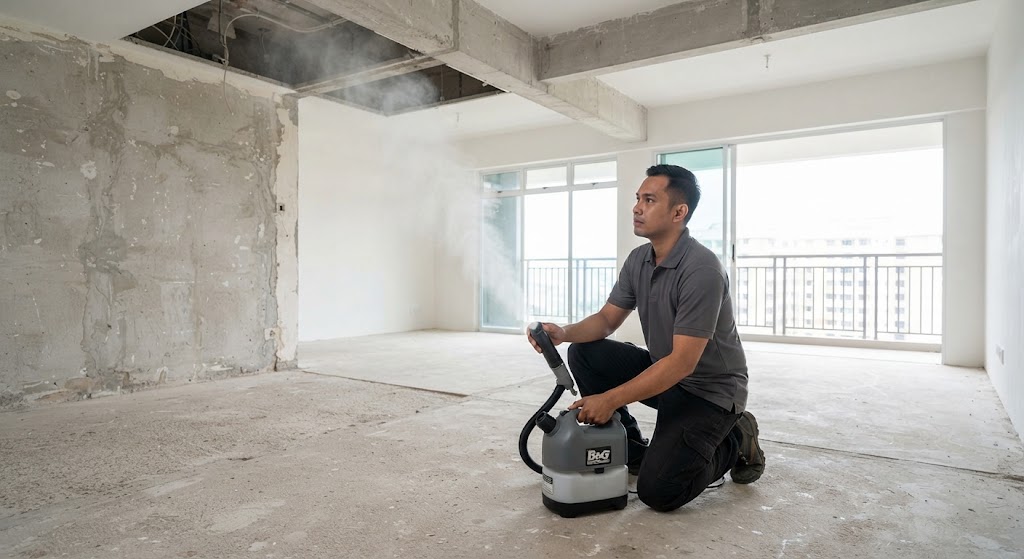
Executing full-space pre-renovation fumigation in resale properties eliminates inherited pest colonies before installing new carpentry.
The Resale Property Biological Reality: What Prior Occupants Leave Behind
Securing a resale HDB flat in a mature estate like Queenstown, Toa Payoh, Ang Mo Kio, or Marine Parade—or acquiring a 15-year-old private condominium unit—offers distinct advantages: prime location, established amenities, and spacious floor plates. However, purchasing a pre-owned residential property in Singapore introduces an invisible biological risk. Unlike brand-new BTO developments fresh from the developer, mature resale flats carry decades of accumulated environmental exposure, tenant turnover, and hidden pest colonies embedded deep within the architectural fabric.
Standard daytime property viewings systematically conceal structural pest problems. When prospective buyers tour a flat, staged ambient lighting, fresh surface paint, and scented diffusers mask deep-seated infestations. Nocturnal vectors like bed bugs (Cimex lectularius), German cockroaches (Blattella germanica), and subterranean termites (Coptotermes gestroi) remain completely hidden inside wall voids, beneath timber parquet flooring, and behind heavy built-in kitchen cabinetry during daylight hours.
When the previous homeowner hands over the keys, their daily routine disappears, disrupting the vectors’ established food and moisture sources. Starving pests immediately begin migrating through expansion joints, electrical conduits, and ceiling voids in search of new hosts. Investing $80,000 to $150,000 in custom interior design, bespoke carpentry, and luxury furnishings without decontaminating the bare building shell leaves your new investment completely vulnerable to inherited colonies.
The Concealed Inherited Pest Spectrum in Mature Properties
Different structural materials and legacy joinery harbor distinct pest species. Identifying the exact biological threat present in a pre-owned Singapore apartment requires examining specific architectural concealment zones:
1. Bed Bug Harborages Behind Timber Skirting and Electrical Conduits
Bed bugs do not live exclusively on mattresses. In mature resale properties where previous occupants suffered chronic infestations, bugs retreat into micro-crevices within 3 meters of sleeping zones. As colonies expand, they colonize hollow timber skirting boards, gaps beneath parquet subflooring, internal cavities of electrical power sockets, and perimeter gaps behind loose wallpaper. Female bed bugs cement viable eggs deep inside structural masonry cracks. These eggs easily survive weeks of vacancy, hatching the moment body heat and carbon dioxide from new occupants are detected.
2. Entrenched German Cockroach Aggregations in Kitchen Joinery
German cockroaches produce aggregation pheromones (found in their feces) that mark specific dark harborages for successive generations. In pre-owned kitchens, the hollow plinths beneath kitchen cabinet carcasses, the unsealed voids behind built-in ovens, and the damp recesses around under-sink plumbing become multi-generational nesting sites. Even if previous owners wipe down laminate countertops, thousands of live nymphs and egg cases (oothecae) remain insulated behind hollow kickplates and tile joints.
3. Subterranean and Drywood Termites in Legacy Woodwork
Mature residential developments in Singapore face continuous termite pressure. Subterranean termites construct hidden mud galleries inside structural expansion joints and service ducts, attacking timber door frames and parquet flooring from beneath the concrete screed. Drywood termites, on the other hand, live entirely inside structural timber without requiring soil contact. They hollow out solid timber doors, false ceiling support battens, and decorative pelmets, leaving only a razor-thin veneer of surface paint that appears structurally sound during a casual visual inspection.
4. Concealed Rodent Pathways in False Ceilings and Aircon Ducts
Older condominiums and top-floor HDB units frequently harbor roof rat (Rattus rattus) activity within suspended false ceilings. Rodents utilize centralized utility risers and air-conditioning pipe chases to traverse between units. They leave behind urine-soaked insulation, pathogenic fecal pellets, and chewing damage on electrical cables, creating severe fire hazards and introducing rodent mites into the home.
The “Bare-Slab Advantage”: Why Pre-Renovation Is the Ultimate Eradication Window
Attempting to eradicate a multi-pest infestation in a fully furnished, occupied home is notoriously difficult. Wall-mounted wardrobes, heavy beds, wall art, and consumer electronics create thousands of acoustic and chemical shadow zones that shield pests from treatment. Furthermore, homeowners must seal food, clear out wardrobes, and relocate pets during occupied pest treatments, severely limiting the intensity of chemical applications.
The pre-renovation and post-hacking phase provides the ultimate Bare-Slab Advantage. When an old flat is stripped down to its raw concrete floor slab, exposed brickwork, and bare ceiling soffit, all structural hiding places are completely exposed:
- Unimpeded Volumetric Penetration: Professional aerosolized space treatments, thermal mists, and ultra-low volume (ULV) cold fogging disperse evenly across the entire cubic volume of the flat, penetrating exposed masonry fissures without obstruction.
- Zero Ingestion or Staining Risk: Technicians can apply higher-concentration non-repellent residual insecticides, bio-decontaminants, and insect growth regulators (IGRs) directly to perimeter slab edges and pipe chases without worrying about staining expensive furniture or exposing children and pets.
- Immediate Structural Sanitization: Any vector colonies flushed out by the treatment die directly on bare concrete, allowing renovation contractors to sweep them away before new timber framing, vinyl flooring, or custom carpentry are installed.
Volumetric Penetration Efficiency: Empty Pre-Renovation Shell vs. Furnished Occupied Unit
Comparative diagnostic analysis of chemical coverage and mortality rates in residential multi-family housing.
Resale Property Diagnostic and Treatment Decision Matrix
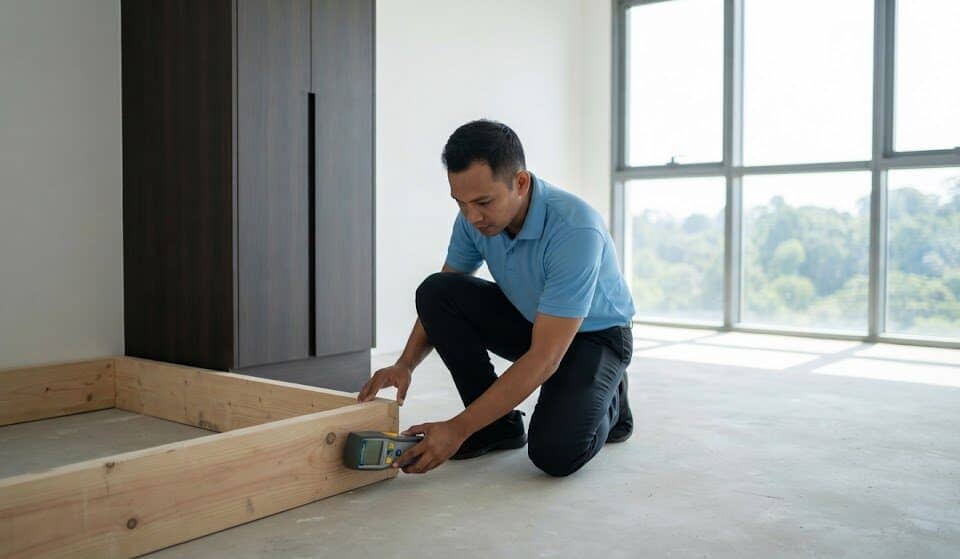
Before beginning renovation hacking or carpentry installation, conduct a systematic structural survey across all high-risk zones. The matrix below outlines the primary inherited pest risks and corresponding technical decontamination protocols required for each architectural feature.
| Architectural Zone | Primary Inherited Pest Threat | Concealment Mechanics & Harborages | Failure Risk If Left Untreated | Mandatory Decontamination Standard |
|---|---|---|---|---|
| Kitchen Cabinetry & Plinths | German Cockroaches (Blattella germanica) | Hollow kickboards, unsealed gap behind laminate backing, electrical motor housing of built-in appliances. | Severe Outbreak (Nymphs cross-infest new bespoke cabinets within 14 days). | Complete structural removal of old joinery; high-pressure ULV misting of bare wall tiles; non-repellent residual barrier application. |
| Parquet Flooring & Skirting | Bed Bugs (Cimex lectularius), Subterranean Termites | Micro-gaps beneath timber strips, degraded bitumen adhesive underlay, hollow wooden skirting boards. | Structural & Parasitic Risk (Bites on new occupants; subfloor timber hollowed out). | Sub-slab pinhole injection with termiticide; superheated dry vapor steam along expansion joints; borate baseboard impregnation. |
| Suspended False Ceilings | Roof Rats (Rattus rattus), Rodent Mites | Unseen crawlspace above gypsum boards, aircon refrigerant trunking pathways, lighting cut-out voids. | High Hygiene Risk (Urine stains, foul odors, insulation destruction, wire gnawing). | Acoustic inspection; mechanical removal of contaminated insulation; thermal misting with bio-sanitizers; ceiling void rodent trapping. |
| Drywall Partition Voids | Subterranean Termites, Pharaoh Ants | Hollow internal cavity between gypsum boards and metal stud framing; paper backing on drywall sheets. | Moderate-to-High Risk (Termites consume drywall paper lining; ant satellite nesting). | Drill-and-treat dust injection using synthetic pyrethroid/borate formulations; seal base track perimeter with elastomeric acoustic caulk. |
| HDB Bomb Shelters & Storerooms | Booklice (Psocoptera), Silverfish, Spiders | Dark, unventilated concrete enclosures; stagnant air promoting micro-mold on stored cardboard and timber. | Nuisance Risk (Massive mold and psocid blooms inside sealed storerooms). | Space decontamination via cold ULV misting; anti-fungal wall misting; compressor dehumidification during curing. |
Fumigation vs. ULV Cold Misting vs. Residual Barrier Spraying: Technical Demarcation
Homeowners and renovation contractors often use the term “fumigation” as a catch-all phrase for any pest treatment. In professional vector control, however, different chemical delivery methods serve distinct technical functions:
1. True Gaseous Fumigation (Structural Enclosure)
True fumigation involves releasing toxic gas (such as sulfuryl fluoride or phosphine) inside a completely sealed, gastight structure. Because multi-unit residential buildings in Singapore share common ventilation risers, drainage stacks, and corridor walls, true gaseous fumigation is restricted under National Environment Agency (NEA) regulations to standalone landed estates, shipping containers, and industrial warehouses. It is never deployed in occupied or multi-family HDB and condominium complexes due to cross-unit gas migration risks.
2. Ultra-Low Volume (ULV) Cold Misting (Space Decontamination)
ULV cold misting is the industry standard for full-space decontamination in residential resale apartments. Specialized electric generators break down water-based or oil-based chemical formulations into microscopic droplets ranging from 10 to 30 microns in diameter. These micro-droplets remain suspended in the air for up to 45 minutes, drifting deep into ceiling voids, unsealed electrical chases, expansion joints, and masonry cracks. ULV misting delivers rapid knockdown of all exposed adult insects, flying pests, and surface nymphs without wetting walls or leaving sticky residues.
3. Micro-Encapsulated Residual Barrier Spraying
While ULV misting purges active airborne and surface pests, residual barrier spraying provides long-term defense. Licensed technicians apply micro-encapsulated formulations (such as lambda-cyhalothrin or non-repellent fipronil) directly along structural perimeters, floor-to-wall junctions, window frames, and plumbing penetrations. The active ingredient bonds to concrete and plaster, creating an invisible, lethal contact barrier that eliminates newly hatched nymphs or wandering pests for up to 90 days post-treatment.
The Tactical Renovation Timeline: When to Schedule Fumigation and Misting
Timing your pest decontamination during a residential renovation determines whether the treatment delivers total colony collapse or leaves surviving pockets hidden behind new joinery. Coordinating with your interior designer (ID) or main contractor ensures the chemical treatments integrate seamlessly into the construction schedule without causing site delays.
A multi-stage residential overhaul in Singapore should align pest control across three primary renovation phases:
Stage 1: The Post-Hacking Phase (Maximum Structural Exposure)
The post-hacking phase represents the single best moment for aggressive chemical and thermal remediation. Once old built-in wardrobes, kitchen carcasses, false ceilings, and wall tiles are hacked away, the apartment exists as a raw concrete and brick shell. Treating the property at this exact juncture ensures aerosolized mist droplets reach deep into perimeter expansion joints, exposed structural chases, and masonry cracks that will soon be permanently enclosed by new drywall or cabinetry.
Stage 2: The Pre-Carpentry Installation Phase (Barrier Placement)
After new cement screeding has cured and drywall framing is erected—but before bespoke carpentry carcasses and floor-to-ceiling wardrobes are mounted—technicians apply long-lasting non-repellent residual barriers along wall-to-floor junctions and behind plumbing stacks. This establishes a continuous chemical defense perimeter on the masonry. If any subterranean pests attempt to forage out from adjacent units or utility shafts, they cross this treated perimeter before reaching your new timber investments.
Stage 3: The Pre-Move-In Final Cleanse (48 Hours Before Furniture Delivery)
Following the final post-renovation chemical wash and deep cleaning, conduct a final ultra-low volume (ULV) space decontamination 48 hours before your moving company delivers soft furnishings, mattresses, and clothing. This final treatment neutralizes any stray insects brought in by renovation contractors, delivery crates, or packaging materials during the finishing works, handing you a completely sterile, pest-free home.
Pest Eradication Success Rate vs. Treatment Timing in the Renovation Lifecycle
Empirical analysis showing near-total eradication success when space decontamination occurs during the bare-shell post-hacking stage.
Structural Proofing Protocols for Older Resale Units
Chemical treatments eliminate existing biological populations, but physical exclusion stops future pests from migrating into your flat from neighboring units or common utility shafts. Older HDB estates and mature condominiums feature specific architectural vulnerabilities that must be sealed during the renovation phase:
1. Sealing Service Yard Drainage Stacks and Soil Pipes
In older apartments, cast-iron or uPVC waste pipes pass vertically through floor slabs in the kitchen and service yard. Over time, the structural mortar surrounding these pipe penetrations shrinks and cracks, leaving a 5mm to 15mm annular gap between the pipe and the concrete slab. This gap acts as an open highway for cockroaches and rodents moving between floors. Require your main contractor to pack these voids with 304-grade stainless steel mesh before sealing the collar permanently with non-shrink structural grout and fire-rated intumescent mastic.
2. Upgrading Refuse Hopper Enclosures
If your resale flat features an individual rubbish chute hopper inside the kitchen, replace the entire legacy steel hopper unit with an updated stainless steel hopper featuring an integrated silicone neo-gasket and a self-closing magnetic latch. Apply acoustic silicone along the entire perimeter rim where the hopper frame meets the kitchen wall tile, ensuring that thermal convection drafts cannot pull sewer roaches into your kitchen cabinets.
3. Masonry Expansion Joints and Parquet Subfloors
When retaining existing solid timber parquet or marble flooring, inspect the perimeter expansion gaps along baseboards. Decades of settling leave hollow voids beneath skirting boards where bed bugs and silverfish congregate. Clean out accumulated debris from these perimeter gaps and inject low-expansion polyurethane foam or flexible silicone caulk before mounting new timber skirting.
Emergency Discovery Action Plan: Uncovering Severe Infestations During Hacking
When demolition contractors hack away old wall tiles, built-in wardrobes, or false ceilings, they frequently uncover massive, active colonies of subterranean termites or nesting bed bugs. Execute this immediate containment protocol:
- Halt Demolition in the Affected Zone: Instruct workers to stop hacking immediately in that room. Aggressive physical hammering shatters termite mud tubes and scatters bed bug clusters across the entire flat.
- Do Not Spray Over-the-Counter Aerosols: Spraying supermarket bug sprays causes chemical panic, forcing subterranean termites to abandon the immediate timber and retreat into deep masonry wall voids, making professional baiting much harder.
- Seal the Room Perimeter: Close internal doors and hang heavy plastic drop sheets over open doorways with masking tape to prevent fleeing insects from spreading into clean rooms.
- Request an Emergency On-Site Inspection: Contact an NEA-licensed vector control operator for same-day diagnostic assessment, direct termiticide foaming, or immediate ULV cold misting before resuming demolition work.
Professional Full-Scope Space Decontamination and IPM Standards
Executing an effective pre-move-in purge requires specialized equipment that domestic cleaning companies cannot provide. True structural decontamination combines mechanical extraction, superheated dry steam, and advanced non-repellent chemical application.
Our licensed specialists deploy an integrated, full-scope space decontamination protocol through our dedicated pre-move-in fumigation and space misting services:
- Ultra-Low Volume (ULV) Aerosol Misting: High-output generators convert specialized water-based pyrethroid and bio-decontaminant formulations into a dense micro-fog. The microscopic droplets drift into ceiling voids, unsealed electrical junction boxes, and perimeter wall cracks, neutralizing all exposed vectors within minutes.
- Targeted Non-Repellent Chemical Barriers: Technicians apply non-repellent liquid formulations (such as fipronil or chlorfenapyr) combined with Insect Growth Regulators (IGRs) along baseboard perimeters and plumbing entries. Foraging insects cannot detect the chemical, walking directly across treated surfaces and carrying lethal doses back to deep nesting sites.
- Superheated Dry Vapor Steaming: Commercial boilers generating dry steam at 180°C and 8 bar pressure penetrate legacy parquet floor seams, door frames, and window sills, instantly denaturing bed bug eggs and killing wood-boring larvae on contact.
Frequently Asked Questions on Resale Property Pre-Move-In Fumigation
How soon after pre-renovation ULV misting can my renovation contractors re-enter the flat?
Following a standard residential ULV cold misting treatment, the property must remain sealed with all windows and doors closed for approximately 3 to 4 hours. This allows the aerosolized micro-droplets to settle evenly across all surfaces and achieve complete pest knockdown. After the 4-hour mark, contractors or homeowners can open all windows for 30 minutes of cross-ventilation, after which the flat is completely safe for full-day construction work.
Will pre-move-in space misting damage freshly painted walls, new vinyl flooring, or designer carpentry?
No. Professional ULV cold misting utilizes advanced water-based formulations calibrated to an ultra-fine droplet spectrum (10 to 30 microns). The mist settles as an invisible, microscopic film that does not pool, drip, stain emulsion paint, or warp timber laminates. It leaves zero oily residues on vinyl flooring or quartz countertops, requiring only a light surface wipe-down on food preparation areas before moving in.
Do I need to notify my condo management (MCST) or Town Council before carrying out space misting?
For standard indoor ULV cold misting within your private unit, formal MCST or Town Council approval is generally not required because cold mist does not generate hot smoke that triggers building fire alarms. However, technicians always advise keeping your main entrance door and service yard windows closed during treatment to prevent mist from drifting into common lift lobbies or corridors.
Is pre-renovation fumigation necessary if the previous owner kept the resale flat very clean?
Yes. Surface cleanliness during daytime viewings is misleading. Vectors like bed bugs, subterranean termites, and German cockroaches nest deep inside structural voids, under parquet flooring, and behind built-in cabinetry where regular domestic cleaning never reaches. When previous owners move out and remove their furniture, hungry pests scatter outward into the open apartment, making a pre-renovation treatment essential regardless of surface appearance.
Can I use supermarket insecticide smoke bombs instead of professional ULV misting?
Consumer aerosol smoke bombs and bug foggers are largely ineffective for whole-home decontamination. They release coarse chemical droplets that fall rapidly onto exposed floor surfaces without penetrating tight structural crevices where bed bugs and roaches hide. Furthermore, consumer foggers contain pyrethroid repellents that trigger chemical agitation, causing pests to scatter into wall voids and neighboring units rather than achieving true colony elimination.
Start Your New Home Journey with a Pristine, Pest-Free Shell
Purchasing a resale HDB or private condominium is a major life milestone. Allowing inherited pest colonies to compromise your brand-new bespoke carpentry, flooring, and designer furnishings turns what should be an exciting handover into an expensive remediation nightmare.
Take full advantage of the bare-slab renovation window by conducting a professional space decontamination before installing your new joinery. Contact our team of NEA-licensed, BCA-certified vector control specialists today to schedule a pre-renovation structural assessment, targeted ULV space misting, and long-term residual barrier defense to guarantee that your dream home starts with a clean, healthy, and pest-free foundation.