Inter-Monsoon Flash Floods & Sewer Rat Invasions: Complete Ground-Floor Exclusion Guide for Singapore Homes (2026 Edition)
August 8, 2026
Resale HDB & Condo Pre-Move-In Fumigation: The Complete Pre-Renovation Pest Eradication Guide (2026 Edition)
August 10, 2026Singapore Office Flu Outbreak Prevention: Workplace Disinfection & Commercial Sanitization Protocol (2026 Guide)
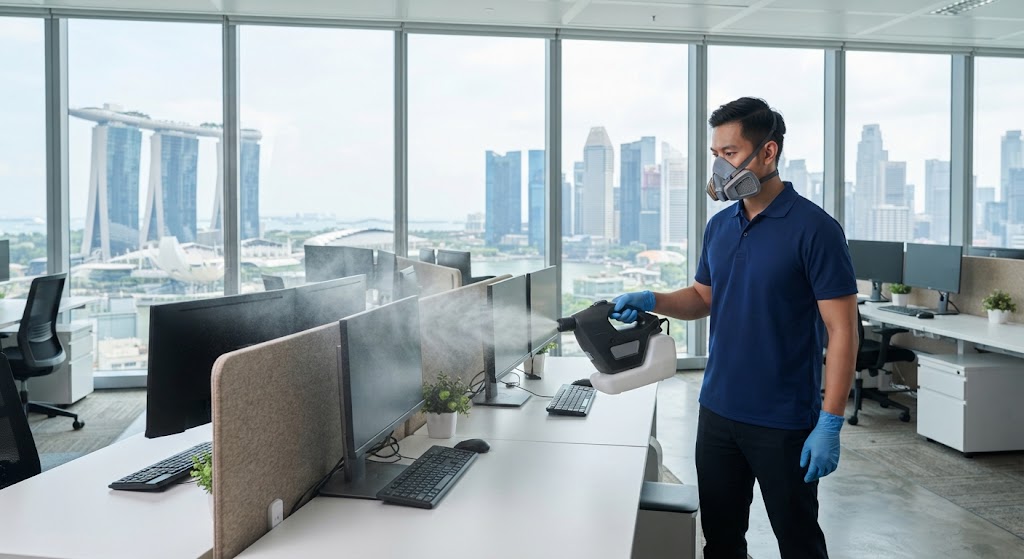
Commercial electrostatic disinfection and high-touch surface sanitization stop viral transmission across high-density Singapore workplaces.
The 2026 Return-to-Office Density and Seasonal Flu Dynamics in Singapore
As corporate organizations across Singapore solidify full-scale Return-to-Office (RTO) policies, commercial real estate in key commercial districts—including Raffles Place, Marina Bay, one-north, and regional business centers in Jurong East and Changi Business Park—is operating at peak occupant density. Modern agile workplace strategies have replaced assigned seating with flexible hot-desking systems. While hot-desking maximizes floor-plate efficiency, it introduces a severe biological vulnerability: multiple employees rotate through the exact same desk surface, computer keyboard, monitor arm, and task chair within a single 24-hour cycle.
Singapore experiences two distinct seasonal spikes in acute respiratory infections (ARI) annually, closely tracked by the Ministry of Health (MOH). The first wave typically coincides with the mid-year southern hemisphere winter (May through July), followed by a second surge during the northern hemisphere winter season (November through January). In sealed commercial office buildings where centralized Air Handling Units (AHUs) continuously recirculate climate-controlled air at 22°C to 24°C, viral pathogens remain viable on synthetic surfaces far longer than in outdoor tropical environments.
When an employee reporting to work with mild respiratory symptoms coughs or touches shared office hardware, pathogens spread rapidly. A single infected worker can spark an absenteeism cluster within 72 hours, triggering a cascade of medical leave (MC) submissions, depleted departmental project teams, and severe productivity losses. Standard daily janitorial cleaning—which typically relies on dry dust mopping and the rapid wiping of desks with a single, contaminated microfiber cloth—is wholly inadequate for controlling viral outbreaks. Commercial workplace defense demands an engineered, microbially validated disinfection protocol.
Microbiology of Workplace Pathogens: Fomite vs. Droplet Vectors
Controlling workplace disease transmission requires understanding the physical survival mechanisms of common respiratory pathogens. While airborne droplets generated by coughing and sneezing initiate transmission, fomite-mediated contact (indirect transmission via contaminated non-porous surfaces) accounts for up to 50% of secondary respiratory infections in closed office layouts.
1. Enveloped Respiratory Viruses (Influenza A & B, RSV, Coronaviruses)
Influenza viruses possess an outer lipid bilayer envelope studded with glycoprotein spikes (hemagglutinin and neuraminidase). This lipid membrane makes enveloped viruses susceptible to specialized chemical surfactants and oxidizers. However, when suspended inside microscopic droplets of human mucus or saliva, these viruses survive on smooth office laminates, stainless steel elevator buttons, and acrylic sneeze guards for 24 to 48 hours in climate-controlled indoor air.
2. Non-Enveloped Pathogens (Human Rhinovirus, Adenovirus, Norovirus)
Non-enveloped viruses lack a protective outer lipid membrane, relying instead on a dense, durable protein capsid shell. This structure gives them exceptional environmental resilience. Human Rhinovirus (the primary cause of the common cold) and Adenovirus resist mild alcohol-based wipes and remain infectious on plastic computer mice, phone touchscreens, and meeting room remote controls for up to 7 days, resisting desiccation at standard office humidity levels (55% to 65% RH).
3. The “Communal Coffee Machine Multiplier”
Cross-contamination studies in corporate facilities demonstrate that when an infected individual touches an un-sanitized high-touch surface—such as the digital touchscreen of a communal bean-to-cup espresso machine or a pantry refrigerator handle—infectious viral particles transfer to the hands of 60% of subsequent users within 4 hours. Those employees then carry the bio-load back to their respective workstations, contaminating individual keyboards, desktop accessories, and meeting room door handles across the entire floor.
Comparative Pathogen Persistence: Viral Survival Duration Across Common Office Substrates
Laboratory persistence data under standardized commercial office indoor climate conditions.
Workplace High-Touch Diagnostic and Chemical Disinfection Matrix
Not all office surfaces carry the same pathogen risk. Treating an entire office floor effectively requires categorizing assets by contact frequency, organic soil accumulation, and material compatibility. The matrix below outlines the microbial risk profiles and corresponding chemical disinfection standards required for key commercial zones.
| High-Touch Office Asset | Typical Pathogen Bio-Load (RLU) | Cross-Contamination Threat | Mandatory Wet Dwell Time | Recommended Chemical Formulation |
|---|---|---|---|---|
| Hot-Desk Keyboards & Mice | 600–1,200 RLU (Extremely High Organic Debris) | Critical Risk (Direct manual transfer to mucous membranes during computer use). | 60 Seconds | Hypochlorous Acid (HOCl 200 ppm) or 70% Isopropyl Alcohol with fast-evaporating carrier; non-corrosive to PCB membranes. |
| Pantry Coffee Machines & Fridge Handles | 850–1,500 RLU (Sugar residues, Milk proteins, Biofilms) | Critical Risk (Central hub touched by 100% of floor staff daily). | 3 to 5 Minutes | Accelerated Hydrogen Peroxide (AHP 0.5%) or 5th-Gen Dual-Chain Quaternary Ammonium Compound; rinse-free food contact safe. |
| Meeting Room AV Remotes & Tablets | 450–800 RLU (Skin oils, Make-up traces, Saliva droplets) | High Risk (Multi-departmental sharing during client presentations). | 2 Minutes | Dual-Chain Quat solution applied via pre-moistened non-woven lint-free wipe; avoid direct liquid pooling on capacitive touchscreens. |
| Biometric Access Scanners & Turnstiles | 500–950 RLU (Fingerprint sebum, Environmental road grime) | High Risk (Primary physical bottleneck at building entry lobby). | 1 to 2 Minutes | Neutral-pH Accelerated Hydrogen Peroxide or hospital-grade germicidal wipes; non-clouding to optical glass sensors. |
| Task Chair Armrests & Adjustment Levers | 350–700 RLU (Sweat, Skin flakes, Fabric dust) | Moderate Risk (Sustained physical forearm contact over 8-hour shifts). | 3 Minutes | Broad-spectrum Quaternary Ammonium Compound (QAC) with corrosion inhibitors; safe for molded polyurethane foam. |
Chemical Efficacy and Dwell Time Science: Active Formulations for Commercial Workplaces
The most widespread failure in corporate sanitization is the “spray-and-wipe” error. Janitorial staff spray a chemical mist onto a desk and immediately wipe it off within three to five seconds. Chemically, this achieves near-zero microbial log reduction. Disinfectants rely on biochemical reaction kinetics to penetrate protective organic mucus, dissolve viral lipid bilayers, and denature viral capsid proteins. Every disinfectant requires a specific contact dwell time—the exact duration the chemical solution must remain visibly wet on the surface to achieve its laboratory-certified kill rate.
Commercial facility managers in Singapore should evaluate three primary active chemical classes approved under NEA and international health guidelines:
1. Fifth-Generation Dual-Chain Quaternary Ammonium Compounds (QACs)
Modern 5th-generation QACs combine dialkyl methyl amines with benzyl chloride complexes. Unlike older, corrosive chlorine bleach solutions that damage office electronics and release toxic fumes, dual-chain QACs deliver rapid 4-log (99.99%) viral inactivation at neutral pH levels. They act as cationic surfactants, binding to the negatively charged cell walls of bacteria and the lipid envelopes of influenza viruses, causing structural lysis within 2 to 3 minutes of wet contact. They leave a micro-thin, non-sticky bacteriostatic layer that inhibits immediate microbial re-colonization.
2. Accelerated Hydrogen Peroxide (AHP)
AHP technology blends low-concentration hydrogen peroxide (0.5% to 1.0%) with specialized anionic surfactants and chelating agents. The synergistic formulation accelerates the oxidative breakdown of viral nucleic acids, achieving full germicidal and virucidal kill within 30 to 60 seconds. AHP decomposes entirely into harmless water and oxygen vapor, making it the premier choice for green-certified corporate offices, eco-conscious tenant fit-outs, and shared pantry dining zones where chemical residues must be avoided.
3. Hypochlorous Acid (HOCl)
Generated through the controlled electrochemical activation of pure salt and water, HOCl is the exact antimicrobial compound produced naturally by human white blood cells to neutralize invading pathogens. With a neutral pH between 5.5 and 6.5, HOCl carries zero electrical charge, allowing it to penetrate viral protein shells 80 to 100 times faster than standard sodium hypochlorite (household bleach). It is non-hazardous, non-irritating to eyes and skin, non-bleaching to office carpets, and safe for ultra-fine misting across complex open-plan workstation banks.
Electrostatic Misting vs. ULV Cold Fogging vs. Manual Wipe-Downs
Selecting the correct delivery mechanism is just as vital as choosing the active chemical formulation. Applying an advanced disinfectant using primitive application tools results in uneven chemical distribution, missed surface voids, and wasted capital. Commercial facility managers must understand the physical mechanics separating manual wiping, Ultra-Low Volume (ULV) cold fogging, and electrostatic spray application.
1. The Limitations of Manual Wipe-Downs
Manual wiping with microfiber cloths is the standard baseline for daily janitorial maintenance, but it possesses fundamental physical limits during viral outbreak seasons. Human cleaners naturally miss 30% to 50% of complex surface contours—such as the undersides of conference tables, keyboard keycap crevices, and chair adjustment mechanisms. Without strict, color-coded rag rotation protocols, a cloth used to wipe down a contaminated pantry table transfers live viral particles directly onto adjacent hot-desks.
2. Ultra-Low Volume (ULV) Cold Fogging
ULV fogging generators utilize high-pressure pneumatic nozzles to shear liquid disinfectants into airborne micro-droplets (10 to 30 microns). While excellent for air space decontamination and neutralizing airborne bio-aerosols in enclosed meeting pods, ULV droplets lack directional electrical charge. They settle passively via gravity, coating only top-facing horizontal surfaces while leaving vertical partition walls, monitor undersides, and recessed door handles untreated.
3. Electrostatic Precision Misting (3D Wraparound Coverage)
Electrostatic technology represents the gold standard for high-density workplace sanitization. As the disinfectant liquid passes through the sprayer nozzle, an internal electrode injects a positive electrical charge (+60 kV) into each atomized droplet. The positively charged micro-droplets repel one another in mid-air, creating a fine, uniform spray pattern. Because target office surfaces (desks, computers, chairs, door frames) carry a natural negative or neutral ground charge, the droplets are drawn to target surfaces with an electrostatic attraction force 75 times stronger than gravity.
- 360-Degree Wraparound Effect: As charged droplets approach an object (such as an ergonomic task chair or desk monitor), they curve around the structure, coating the sides, back, and underside evenly.
- Zero Liquid Pooling: The uniform electrostatic repulsion prevents droplets from coalescing into large puddles, ensuring rapid drying within 3 to 5 minutes without damaging sensitive office electronics or leaving sticky residues on documents.
Quantitative Cleanliness Verification: ATP Bioluminescence Swab Benchmarking
You cannot manage what you do not measure. Evaluating workplace hygiene through visual inspection alone is completely ineffective; a desk surface can appear polished and clean while harboring millions of active microbial cells. Corporate facility managers should implement objective, data-driven validation using Adenosine Triphosphate (ATP) Bioluminescence Swab Testing.
ATP is the universal energy molecule present in all living cells, including bacteria, human skin cells, organic food soils, and microbial biofilms. Technicians swab a standardized 10 cm x 10 cm surface zone and insert the swab into a luminometer chamber. The device mixes the sample with a specialized luciferin-luciferase enzyme reagent, producing a bioluminescent reaction. The light emitted is measured in Relative Light Units (RLU)—the higher the RLU reading, the higher the biological soil level on that asset.
| Workplace Hygiene Zone | Target Pass Benchmark (RLU) | Caution / Re-Clean Threshold | Critical Failure Level (Bio-Hazard Risk) | Corrective Action Protocol |
|---|---|---|---|---|
| Hot-Desk Workstations & Keyboards | < 100 RLU | 101 – 250 RLU | > 250 RLU | Immediate alcohol-safe HOCl electrostatic misting; replace high-wear silicone keyboard skins. |
| Communal Pantry Prep & Dining Tables | < 50 RLU (Food Contact Standard) | 51 – 150 RLU | > 150 RLU | Deep degreasing with enzymatic bio-cleaner followed by food-grade Accelerated Hydrogen Peroxide wipe-down. |
| Meeting Room Presentation Remotes & Tabs | < 80 RLU | 81 – 200 RLU | > 200 RLU | Pre-moistened germicidal wipe contact for 2 full minutes; apply antimicrobial barrier coating. |
| Restroom Door Latches & Flush Valves | < 100 RLU | 101 – 300 RLU | > 300 RLU | Hospital-grade QAC chemical soak with 5-minute dwell time; audit exhaust fan CFM airflow. |
Emergency Action Plan: Responding to a Multi-Employee Workplace Flu Cluster
If three or more employees within the same department or seating zone report acute respiratory illness or submit Medical Certificates (MCs) within a 48-hour window, execute this rapid containment protocol:
- Isolate the Immediate Seating Cluster: Temporarily block out the affected hot-desking zone and adjacent desk pods within a 5-meter radius, redirecting team members to alternate zones or temporary remote work.
- Activate Emergency Whole-Floor Disinfection: Schedule an emergency after-hours electrostatic disinfection sweep covering all shared workstations, meeting rooms, telephone booths, and pantry hubs.
- Purge Indoor Air Volumes: Request building management to set the floor’s Air Handling Unit (AHU) to 100% outdoor air intake for 2 hours post-treatment to exhaust airborne viral bio-aerosols.
- Deploy Hand Hygiene Defense Points: Restock all entry turnstiles, lift lobbies, and printer hubs with 70% ethyl alcohol automated hand rub dispensers.
Workplace Viral Re-Contamination Kinetics and Long-Term Surface Protection
A standard chemical wipe-down provides point-in-time disinfection. The moment an infected employee sits at a sanitized desk the following morning, sneezes, and touches the desktop surface, microbial re-contamination begins immediately. Within 4 to 6 hours of active office use, surface bio-loads rebound to pre-cleaning levels.
Breaking this cycle requires pairing electrostatic disinfection with antimicrobial organosilane surface coatings. These molecular coatings bond covalently to surfaces, forming an invisible, non-toxic microscopic layer of positively charged carbon spikes. When negatively charged viral particles land on the treated surface, the molecular spikes physically puncture the viral membrane on contact, providing continuous mechanical kill for up to 90 days between professional service intervals.
Workplace Bio-Load Rebound: Standard Janitorial Cleaning vs. Residual Antimicrobial Coating
Empirical ATP bioluminescence tracking across 50 hot-desking stations in a Central Business District corporate office.
Professional Commercial Biosecurity and Facility Decontamination Protocols
Achieving total infection control across an entire corporate facility requires specialized commercial equipment and trained technical personnel. General office cleaners are not trained in bio-decontamination contact dwell kinetics, nor do they possess the personal protective equipment (PPE) required to deploy hospital-grade chemical formulations safely.
Our NEA-licensed, certified technicians deploy comprehensive workplace infection defense through our specialized commercial disinfection services in Singapore:
- Full-Facility Electrostatic Decontamination: High-output cordless electrostatic sprayers atomize hospital-grade, broad-spectrum virucidal agents, providing complete 3D wraparound coverage across all open workstations, executive suites, boardrooms, and communal pantries.
- HVAC Coil and Air Handling Unit (AHU) Disinfection: Applying specialized non-corrosive, self-rinsing biocidal foam directly to AHU cooling coils and supply plenums, eliminating fungal biofilms, bacteria, and viral particles trapped in the building’s recirculated airflow.
- Server Room and Sensitive Electronics Treatment: Deploying pure, non-conductive, ultra-fine Hypochlorous Acid (HOCl) dry vapor misting to decontaminate mission-critical data suites, trading desks, and AV equipment without risking liquid ingress or electrical shorts.
- Pre- and Post-Treatment ATP Validation: Providing facility managers with complete digital compliance documentation, including before-and-after ATP swab metrics that quantitatively prove 4-log (99.99%) pathogen reduction across all high-touch assets.
Frequently Asked Questions on Commercial Office Disinfection in Singapore
Will electrostatic disinfection misting damage sensitive office computers, monitors, and server equipment?
No. Professional electrostatic misting breaks chemical solutions down into microscopic, uniformly dispersed droplets (40 to 80 microns). Because the droplets carry a uniform electrical charge, they repel each other and land as an ultra-fine, even film that dries within 3 to 5 minutes without pooling or dripping. It is completely non-conductive and safe for computer keyboards, LCD monitors, conference room AV hardware, and server rack exteriors.
How frequently should a commercial corporate office in Singapore schedule professional disinfection?
For standard corporate offices operating on hot-desking or agile hybrid models, a quarterly full-facility electrostatic disinfection paired with a 90-day antimicrobial barrier coating is recommended. However, during active MOH seasonal flu peaks (May–July and November–January) or when experiencing high in-office attendance, monthly preventive treatments help minimize absenteeism and protect team productivity.
Are the chemical disinfectants used compliant with NEA and MOH regulatory standards?
Yes. All chemical formulations deployed in our commercial disinfection protocols are registered and listed under the National Environment Agency (NEA) Interim List of Household and Commercial Products for Vector and Pathogen Decontamination. Formulations are hospital-grade, non-carcinogenic, non-staining, and certified effective against enveloped viruses (such as Influenza and Coronaviruses) and non-enveloped pathogens (such as Norovirus and Rhinovirus).
How soon after a whole-office disinfection treatment can employees return to their desks?
Because electrostatic misting utilizes fast-drying, hospital-grade formulations that decompose into harmless natural compounds, the standard facility re-entry time is just 30 to 45 minutes following service completion. Technicians recommend running the building’s air conditioning system during and after application to facilitate rapid drying and continuous air exchange.
Does office carpet and fabric upholstery require special disinfection treatments?
Yes. Porous fabrics—such as ergonomic mesh task chairs, acoustic partition screens, and commercial carpet tiles—trap respiratory droplets, shed skin cells, and atmospheric moisture. While electrostatic misting sanitizes the outer surface fibers, heavily soiled fabric chairs benefit from periodic superheated dry vapor extraction (exceeding 160°C) to denature deeply embedded allergens, dust mites, and viral particles.
Safeguard Your Workforce and Ensure Business Continuity
Workplace illness outbreaks erode team morale, drive expensive medical absenteeism, and disrupt critical corporate deliverables. In Singapore’s high-density, hot-desking corporate environment, relying on basic daily janitorial wiping leaves your staff vulnerable to aggressive seasonal respiratory viruses.
Take control of your facility’s biosecurity by implementing engineered electrostatic disinfection, hospital-grade contact dwell protocols, and continuous antimicrobial surface protection. Contact our team of NEA-licensed, certified commercial disinfection specialists today to schedule a comprehensive workplace ATP hygiene audit, deploy whole-office electrostatic sanitization, and keep your business fully operational and protected throughout the flu season.